

In previous articles published on Xylon, we went through many topics in order to give an overview on how doing business today has changed from what it was like fifteen years ago. It’s different because the world has changed, but we have also seen how these changes, if embraced and addressed with the right mindset, can help our companies grow and provide us with new powerful tools.
For us wood craftsmen, strong changes have come along both in the field of production, which we’ve been always accustomed to and it being our greatest strength, and regarding the issues that many have ignored until now usually associated to big company activities, such as marketing, sales and company management/organisation. In somewhat of a short-sighted way, we ignored many of these challenges; we allowed ourselves to postpone them day after day, but as the saying goes, “all the chickens come home to roost”.
For those who haven’t done it yet, it’s better to batten down the hatches. Now is the time to study, understand and master all these concepts. We also need solid tools that can help in our daily duties, because the number of things we have to take care of is ever increasing, and postponing them indefinitely is the equivalent of putting an expiration date on your company, like on yogurt.
Having made these inconvenient, unpopular but dutiful premises, from this issue onwards, we’ll begin to go into detail of a tool particularly dear to me: software.
In the next months, we’ll analyse all the measures and parameters that a software should have to truly be helpful and effective during the growth of your company.
Without going too deep into the origins of software, which is very recent in the history of humanity, an incredible evolution occurred when, in 1975, Bill Gates and Paul Allen gave life to Microsoft Inc., thus laying the groundwork for the next diffusion of the MS-DOS operating system (1982) first, and Windows (1985) second, making IT available to everyone.
But what do we mean with software? To explain the concept of both software and its close-relative, hardware, an analogy regarding the human body is often used. One could roughly (yet correctly) say that hardware is the body while software is the brain. Nowadays I’d say that the entire planet and the lives of almost all human beings are constantly enveloped by software in an infinite number of ways.
Let’s take some examples to understand how much software surrounds us in every single moment of our lives.
In most cases, when we get up in the morning, we don’t wake up to the crowing of a live rooster; instead, we wake up to the sound of a rooster, reproduced from a cell phone that we kissed goodnight just a few hours before. But a cell phone, thanks to its’ sophisticated internal software, can do much more: it can act as a flashlight, take photos, play videos and sounds, take notes on your agenda and sometimes, if there’s signal, it can even make calls. Microwaves and washing machines: just a few parameters on their “user friendly” display and they’ll warm up your food or start washing cycles, following a calculated ending time based on parameters such as washing time, load weight and so on.
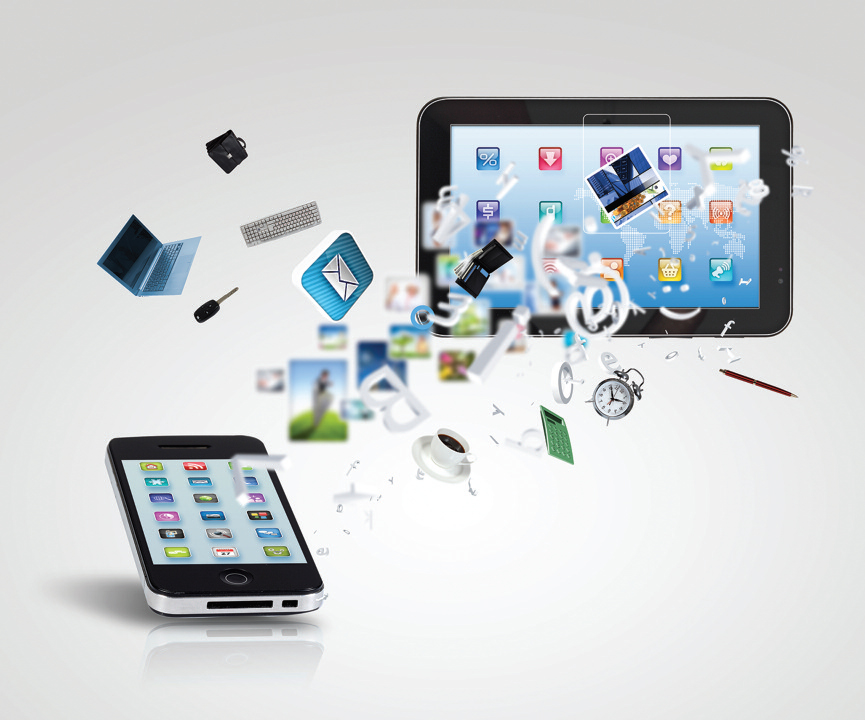
We went from black and white TVs, where you could only watch two channels and required three people to move them, to giant screens with surfaces larger than an indoor soccer field, but so light that two ants could carry them and fully piloted by a software capable of showing thousands of digital channels.
And how about cars? How many people today would be willing to buy a car that lacks ABS? Nowadays cars park themselves with the click of a button. They can do parallel parking, both in the shape of an “L” and a “S” and, thanks to the same kind of software, the automotive industry says that they will soon launch on the market cars that can drive themselves. Naturally, software is part of our personal daily life, but even more so in our daily professional life, where anyone acknowledges that it’s now practically impossible to avoid the topic of software.
Whether you have to engage in business or administration tasks like creating price quotes and invoices, it becomes clear that software is an essential tool today.
Not only because delivering a price quote written by hand is not among the best ways to appeal to customers, but also because there’s a risk that the sheet could soon be recycled into a paper plane or paper boat, losing the agreements made with the customer, as they won’t get stored for later viewing.
Software is even more useful when we create costumer-specific products, like windows, a piece of furniture or a staircase. When constantly designing something new, aside from having to do it quickly, we must also be extremely precise to avoid misunderstandings.
Software can come in handy in that regard, helping us in creating graphic representations which allow our customers to better understand what they’re interested in buying or, in other words, what we’re trying to sell to them.
These are just some very solid examples that show how software, whether we like it or not, are everywhere in our everyday lives, with the aim of making them, as software engineers would say, simpler.
The purpose is undoubtedly noble even though I imagine not everyone would agree with that.
However, as we all know, progress doesn’t stop and therefore, instead of complaining, it’s undoubtedly more convenient to learn more about the issue and understand what the characteristics that we should look for in a software are, in order for it to be a good investment and letting us rest peacefully at night.
In my opinion, one of the most important qualities of a software is its comprehensiveness, its general purpose.
When we talk about a woodworking shop, we talk about a company, a group of activities and people that although diverse, must fit in perfectly with each other with the goal of achieving a common result. It’s like an orchestra: if an instrument is missing, the melody sounds incomplete, and if the instruments are not perfectly in time with each other, the end result is a disaster. The rules in a woodworking shop are the same: we can’t expect to have a functional company if we lack in commercial activities or we don’t keep our internal resources in check.
 Unfortunately, making a nice piece of furniture is not enough anymore to succeed on the market; producing a window that complies with all the regulations is not enough to guarantee a future for your company. Taking the concept of “intelligent company” introduced by Industry 4.0 into account, we understand how indispensable it is nowadays to synchronise all commercial, administrative and organisational activities as well as design and production, with the same philosophy, aided by a single “conductor” that can direct the different departments to play in a homogeneous, harmonious and interconnected way, while also managing all the difficulties at the best of its abilities, preventing the unexpected and producing goods and services so efficiently as to be profitable, even in small quantities.
Just like there cannot be multiple conductors in the same orchestra, it’s inadvisable to have different software managing the different departments/functions of the company, not just because such situation would create confusion, but also for the following reasons. Imagine that in a company there are software A and software B, developed by two different software manufacturers. Here are the problems we are likely to encounter:
1. If, for example, software A is updated, it could lead to communication problems that would require the update of software B. There’s also a chance that updating software B could require payment of a steep fee.
2. If changes are made to the data in software A, it may call for the same changes to be made in software B.
Failure to do so could create dangerous situations and serious damage.
3. Imagine that software A deals with the commercial aspects of the company, while software B deals with the production aspects. There may be production aspects that are affected from data only available in software A, but that software B isn’t able to read. This situation could then lead to the creation of hitches in software B, losing the linearity of the process and generating a poorly maintained situation for future interventions.
4. Often the connection between software A and software B is unidirectional, and this doesn’t allow software A to know what happened in software B.
5. The connection of software A to software B can give rise to costs double the expected amount. There are cases where the software A requires a fee to connect to software B, and software B also requires a fee to connect to software A.
6. It may happen that due to a need of software A (or B), the communication protocol undergoes variations. In this case there is a risk that the other software may require a fee to develop the changes made to the protocol.
7. If problems in the exchange of data arise, there’s a risk that software A and B may play hot potato on responsibility and lead to a waste of time and money. One should keep in mind that although companies A and B may seem on terms at first, no one stops that relationship to change or deteriorate over time. Let’s not forget that statistics on divorce show nothing but growth.
8. If you need support with software A, you’ll have to call a company that will have certain modalities of intervention, and if you need help with software B, you’ll have to call another company, which will have their own set of modalities.
9. Software usually come with assistance contracts, so you will need to pay the contract both for software A and for software B separately each year.
10. Different software are made by different companies, which have different bank accounts and different business goals. Conceptualized at different times, with different philosophies, different interfaces and different objectives.
This is why it’s uncertain if they will able to process or synchronise all the data we need. In this issue we analysed a first characteristic that we should all keep in mind when we decide to bring a software into the company which will be by our side for the next 10-30-70 years. After all, the beauty of software is that, even if you use them a thousand times, they won’t end up full of holes like a pair of jeans and they won’t require oil changes like a car would.
That’s all for now. See you next time with other software tips.